Release time : 2026-11-02 Source :Organizing Committee
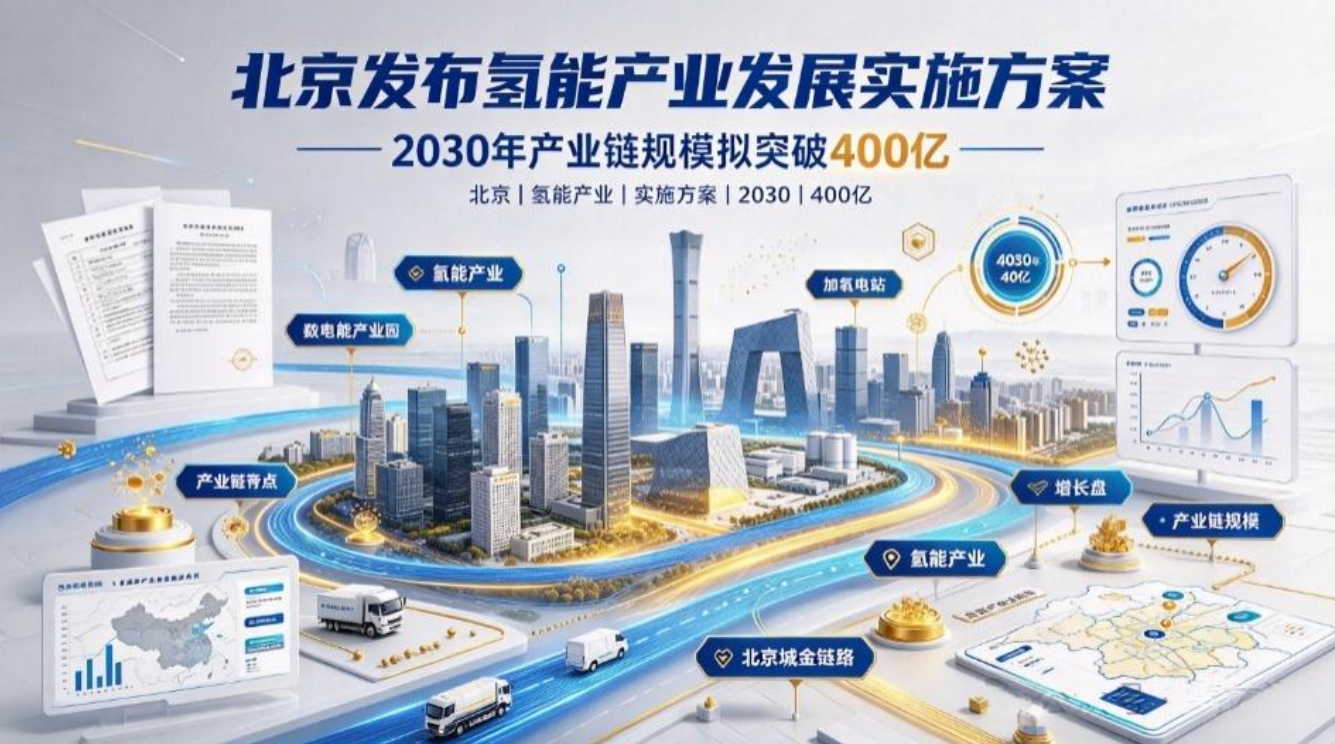
Beijing has officially released the Implementation Plan for Beijing Hydrogen Industry Development (2026–2030). Centered on application demonstration, industrial cultivation, supply security and public platform development, the document sets out four major initiatives covering 14 key tasks to drive coordinated innovation across the full hydrogen value chain. By 2030, Beijing targets a local hydrogen industry-chain scale exceeding RMB 40 billion and aims to push the total value of the Beijing-Tianjin-Hebei regional hydrogen industry past RMB 100 billion.
Road haulage and cold-chain logistics sit at the core of upgraded transportation demonstrations. Beijing plans to add more than 6,000 hydrogen-powered vehicles and build a hydrogen highway network featuring “6 main corridors + 11 branch routes.”
For industrial hydrogen consumption, the city will support Beijing-based petrochemical enterprises in replacing conventional fossil-based feedstock with hydrogen-based chemical feedstock in refining processes. Sustainable Aviation Fuel (SAF) projects will be deployed at Sinopec Yanshan Petrochemical in Beijing’s Fangshan District and at Asuwei in Changping District, delivering more than 35,000 tonnes per year of green-hydrogen off-take capacity and cutting carbon-dioxide emissions by more than 300,000 tonnes annually. A cross-regional pilot will integrate wind- and solar-based hydrogen production in Ulanqab, long-distance cross-regional pipeline transportation, and low-carbon transformation of refining operations at Beijing-based petrochemical enterprises.
Cost reduction and quality upgrading are highlighted as priorities for industrial expansion. Policymakers will back leading enterprises to complete full-value-chain layouts and establish fuel-cell vehicle manufacturing capacity at the 10,000-unit scale. The overall cost of fuel-cell vehicles and key components is targeted to fall by more than 30%.
Fifteen technical items, including low-hydrogen-consumption gaseous-hydrogen heavy-duty trucks and long-range liquid-hydrogen heavy-duty trucks, are included in the key core-technology R&D list. Performance benchmarks are specified: gaseous-hydrogen heavy trucks shall achieve a pure-hydrogen driving range of more than 700 km with hydrogen consumption below 7 kg per 100 km; liquid-hydrogen heavy trucks shall deliver ranges above 1,000 km. Authorities will support the Beijing Hydrogen Industry Innovation Centre to upgrade into a national-level hydrogen innovation centre.
To unlock cross-regional hydrogen supply links, Beijing plans to advance a roughly 1,059-km Ulanqab–Beijing green hydrogen long-distance pipeline, designed to transport 500,000 tonnes of green hydrogen per year. The Capital Green-Hydrogen Supply Hub in Fangshan District is expected to secure annual green-hydrogen supply capacity of more than 50,000 tonnes during the 15th Five-Year Plan period. Combined with by-product hydrogen recovery, the region will adopt a dual-track model combining large-scale green-hydrogen delivery with on-site consumption.
Following the principle of co-locating refuelling infrastructure alongside transport corridors with moderate forward-planning, Beijing will build more than 40 hydrogen refuelling stations, prioritised along hydrogen highway corridors. Leveraging the Beijing-Tianjin-Hebei industrial cluster, a green-hydrogen (green-fuel) trading centre will also be established to strengthen international pricing influence for green-hydrogen products.
The plan lays out a clear development roadmap for Beijing’s hydrogen sector. It is expected to accelerate large-scale collaborative innovation across the hydrogen value chain in the Beijing-Tianjin-Hebei region and to deliver visible medium- to long-term market opportunities for industrial-gas producers, hydrogen-generation equipment suppliers and end-application players.
Beijing has published its 2026–2030 hydrogen industry roadmap, targeting RMB 40 billion in local industrial-chain value by 2030 and RMB 100 billion across Beijing-Tianjin-Hebei. The policy outlines cross-regional green-hydrogen pipeline links with Inner Mongolia, new SAF projects, heavy-duty hydrogen-vehicle roll-out, fuel-cell cost-reduction goals and plans for a regional green-hydrogen trading centre.
Exhibitor/Conference Consultation
Contact: Ms. Becky CHEN
Tel: +86 15910580218
Email: becky@cntigerexpo.com
Exhibitor Consultation
Contact: Mr. Lito HU
Tel: +86 13601321637
Email: lito.hu@cntigerexpo.com
Exhibitor Consultation & Media Cooperation
Contact: Ms. Yasmin ZHENG
Tel: +86 13621183385
Email: zhengyaxin@cntigerexpo.com


