Release time : 2026-11-02 Source :Organizing Committee
On the Gulei Peninsula, two 10 MW wind turbines generate green electricity with a combined maximum output of 20 MW. The power feeds water electrolysis to produce green hydrogen. The resulting hydrogen either refuels hydrogen-powered heavy-duty trucks, flows through pipelines for consumption by petrochemical facilities within the Zhangzhou Gulei Port Economic Development Zone, or remains at the Fujian Green Hydrogen Pilot-Test Base for technical validation, advancing green-hydrogen adoption across broader application fields.
“Green hydrogen is produced via water electrolysis powered by renewable energy. Grey hydrogen comes from the purification of by-product hydrogen generated in petrochemical operations,” explained Han Quanhui, Chief of the Equipment Section at the Zhangzhou Bureau of Industry and Information Technology. The Gulei petrochemical park pursues two parallel pathways: upgrading grey-hydrogen resources and expanding green-hydrogen capacity. Together these build a complete hydrogen value chain covering production, storage, transportation, refuelling and end-use applications. This integrated framework forms the core competitive advantage behind Zhangzhou’s designation as a national comprehensive hydrogen-application pilot city.
Offshore wind power suffers from intermittency and volatility. Delivering a steady green-hydrogen supply for downstream chemical manufacturing at commercial scale requires this bottleneck to be resolved. Real-world pilot tests at the Fujian Green Hydrogen Pilot-Test Base aim to unlock green-hydrogen potential by addressing exactly this challenge.
“Chemical facilities demand safe, uninterrupted operation, yet offshore wind output fluctuates with weather conditions. Our pilot tests enable electrolyser units to dynamically adjust output following variable wind-power profiles. This setup delivers continuous green-hydrogen generation under real-world fluctuating-power conditions while keeping downstream chemical plants running stably,” said Chen Jianzhong, Head of the Quality, Certification and Innovation Centre at Fujian Sea Hydrogen Technology Co., Ltd. Effective coupling between renewable-energy sources and hydrogen downstream applications is critical for project viability.
“Phase I of the pilot-test base focuses on hydrogen production and storage. Phase II is planned to focus on diverse green-hydrogen application scenarios, bridging laboratory-scale R&D and full-scale industrial production,” Chen Jianzhong added. Hydrogen, ammonia and methanol are closely interlinked. For instance, the Green Hydrogen-Ammonia Industrial Demonstration Project in the southern section of Gulei Petrochemical Park plans to build a green-ammonia synthesis unit in Phase I, adopting low-temperature and low-pressure ammonia synthesis technology developed by Fuda-Zijin Hydrogen Energy Science & Technology Co., Ltd. (FZHE), a joint venture between Fuzhou University’s chemical fertilizer catalyst research centre and Zijin Mining. The integrated Gulei Green Methanol Project will be paired with a supporting green-power supply project.
If green hydrogen represents future-oriented incremental capacity built on coastal wind and solar resources, grey-hydrogen utilisation unlocks existing industrial potential rooted in Gulei’s mature petrochemical base. It drives Zhangzhou’s hydrogen-industry development from initial construction toward high-quality advancement.
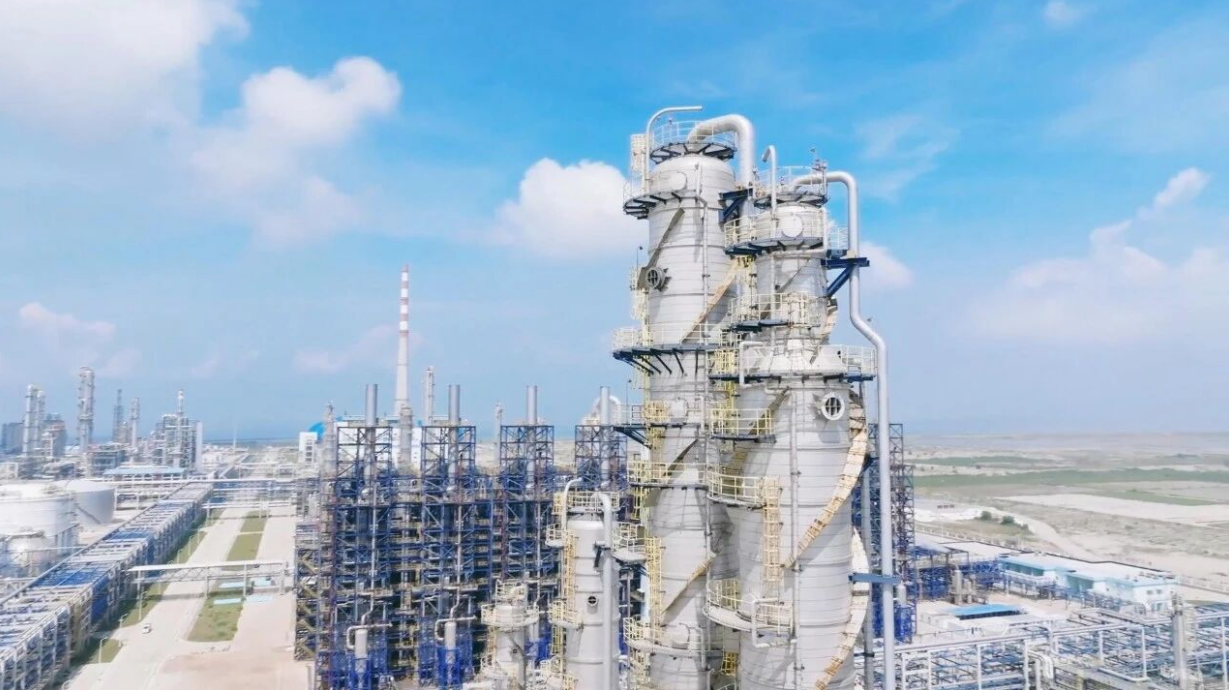
Within Phase I of the Gulei Refining & Chemical Integration Project, PSA hydrogen-purification towers and dense pipeline networks operate like gas-sorting infrastructure. Hydrogen-rich tail gas from refining units enters pressure-swing-adsorption towers to remove impurities, yielding hydrogen with 99.99% purity.
Nearby, the aniline-rubber-auxiliaries industrial-chain project of Sinopec Nanjing Chemical Industrial Co., Ltd. (NCIC, also known as Nanhua) — a key provincial initiative — is nearing commissioning. Its planned 300,000-tonne-per-year aniline output requires approximately 36,000 tonnes of hydrogen feedstock annually. “The newly commissioned PSA hydrogen-purification unit delivers roughly 39,000 tonnes of hydrogen each year, which perfectly matches Nanhua’s feedstock demand,” said Zheng Sheng, PSA Project Manager at Fujian Gulei Petrochemical Co., Ltd. Previously, unpurified hydrogen was mostly treated as waste gas. Today, the purified hydrogen travels through on-site pipelines directly to Nanhua’s production lines. “Nanhua cuts costs through local feedstock access, while we generate extra revenue via resource recycling.” According to Fujian Gulei Petrochemical estimates, hydrogen sales can bring around RMB 180 million in annual revenue for the enterprise.
Leveraging the national-level Gulei petrochemical base, Zhangzhou keeps unlocking hydrogen-industry potential. Late last year, Zhangzhou Gulei Port Economic Development Zone was selected in the first batch of China’s national zero-carbon industrial parks pilot programme. The zone prioritises green hydrogen and green methanol as two hydrogen-based green chemical tracks to foster a full hydrogen-based new-materials industry system.
“Drawing on the Green Hydrogen Pilot-Test Base, we are advancing demonstration projects for green ammonia, green methanol and offshore floating ammonia synthesis. We keep improving hydrogen infrastructure, conducting multi-scenario trials and attracting equipment manufacturers to set up local operations. Going forward, we will scale up green-hydrogen capacity, build green-chemical industrial clusters, extend the hydrogen value chain and realise integrated R&D and manufacturing. Our goal is to establish a leading hydrogen-industry hub on China’s southeast coast,” commented Lin Yonghua, a senior official at the Economic Development Bureau of Gulei Economic Development Zone.
“Expand incremental renewable green-hydrogen supply and promote purification and high-value utilisation of industrial by-product hydrogen,” Han Quanhui summarised. Building on its national pilot-city status, Zhangzhou will reinforce local hydrogen-source capacity, densify municipal hydrogen-refuelling infrastructure networks and diversify end-use demonstration cases. Systematic, forward-looking and full-value-chain planning will drive iterative upgrading of the local hydrogen sector, cementing Zhangzhou’s position as a major hydrogen-industry hub in Fujian and Southeast China.
Exhibitor/Conference Consultation
Contact: Ms. Becky CHEN
Tel: +86 15910580218
Email: becky@cntigerexpo.com
Exhibitor Consultation
Contact: Mr. Lito HU
Tel: +86 13601321637
Email: lito.hu@cntigerexpo.com
Exhibitor Consultation & Media Cooperation
Contact: Ms. Yasmin ZHENG
Tel: +86 13621183385
Email: zhengyaxin@cntigerexpo.com


