Release time : 2026-10-09 Source :Organizing Committee
Inner Mongolia has received the first RMB 470 million (approximately $66 million) tranche of central-government incentive funding for China’s national hydrogen comprehensive-application pilot programme, according to the Inner Mongolia Daily, citing the regional Department of Finance.
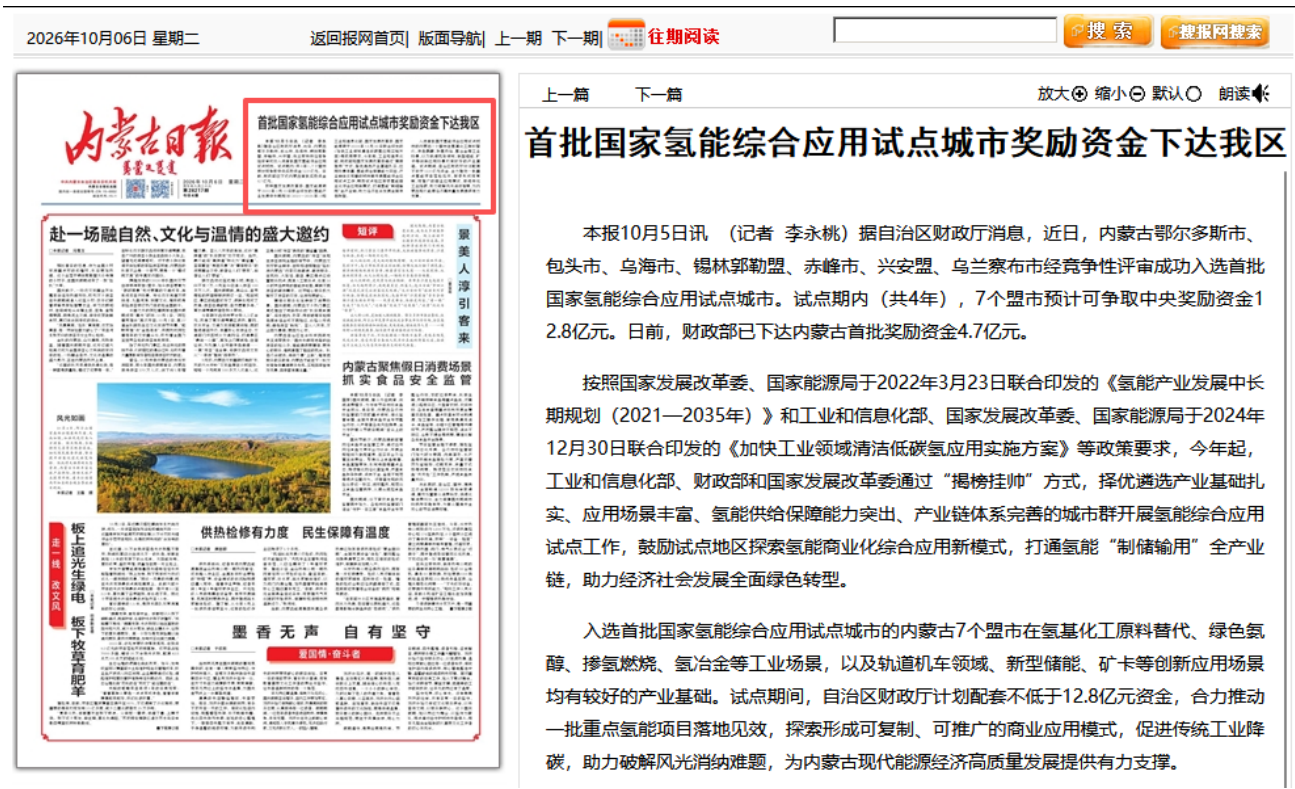
Seven cities and leagues in the autonomous region—Ordos, Baotou, Wuhai, Xilingol League, Ulanqab, Chifeng and Hinggan League—were selected through a competitive review to participate in the four-year pilot programme. Together, they are expected to secure up to RMB 1.28 billion (approximately $180 million) in central-government incentive funding over the pilot period.
The seven jurisdictions are part of three pilot city clusters. Ordos, Baotou, Wuhai and Xilingol League belong to the Yellow River “Ji-shaped Bend–Central Plains” cluster; Ulanqab is part of the Beijing–Tianjin–Hebei cluster; and Chifeng and Hinggan League are included in the Northeast China (including eastern Inner Mongolia)–Yangtze River Delta cluster.
China’s national programme covers five city clusters under a “two plus three” framework. The Beijing–Tianjin–Hebei and Greater Bay Area clusters will focus mainly on fuel-cell vehicles and hydrogen-powered transport. The other three clusters—the Northeast China–Yangtze River Delta, Xinjiang–Chengdu–Chongqing, and Yellow River “Ji-shaped Bend”–Central Plains clusters—will prioritise industrial applications, including green ammonia and methanol, hydrogen metallurgy, replacing conventional chemical feedstocks with hydrogen-based alternatives, and hydrogen blending in combustion processes.
The pilot in Inner Mongolia will draw on the region’s abundant wind and solar resources to produce green hydrogen through water electrolysis powered by renewable electricity. The approach is intended to absorb surplus renewable power and reduce wind and solar curtailment, while supplying low-carbon fuels and feedstocks to energy-intensive sectors such as steelmaking, chemicals and transport.
The seven selected jurisdictions already have industrial foundations for applications including hydrogen-based chemical feedstock substitution, green ammonia and methanol production, hydrogen-blended combustion and hydrogen metallurgy. Potential innovative applications also include rail locomotives, new-type energy storage and mining trucks.
During the pilot period, the Inner Mongolia regional Department of Finance plans to allocate at least RMB 1.28 billion in complementary funding. The combined support is intended to help bring key hydrogen projects into operation, develop commercial models that can be replicated and scaled up, decarbonise traditional industries, improve renewable-energy utilisation and support the high-quality development of Inner Mongolia’s modern energy economy.
Exhibitor/Conference Consultation
Contact: Ms. Becky CHEN
Tel: +86 15910580218
Email: becky@cntigerexpo.com
Exhibitor Consultation
Contact: Mr. Lito HU
Tel: +86 13601321637
Email: lito.hu@cntigerexpo.com
Exhibitor Consultation & Media Cooperation
Contact: Ms. Yasmin ZHENG
Tel: +86 13621183385
Email: zhengyaxin@cntigerexpo.com


