Release time : 2026-10-09 Source :Organizing Committee
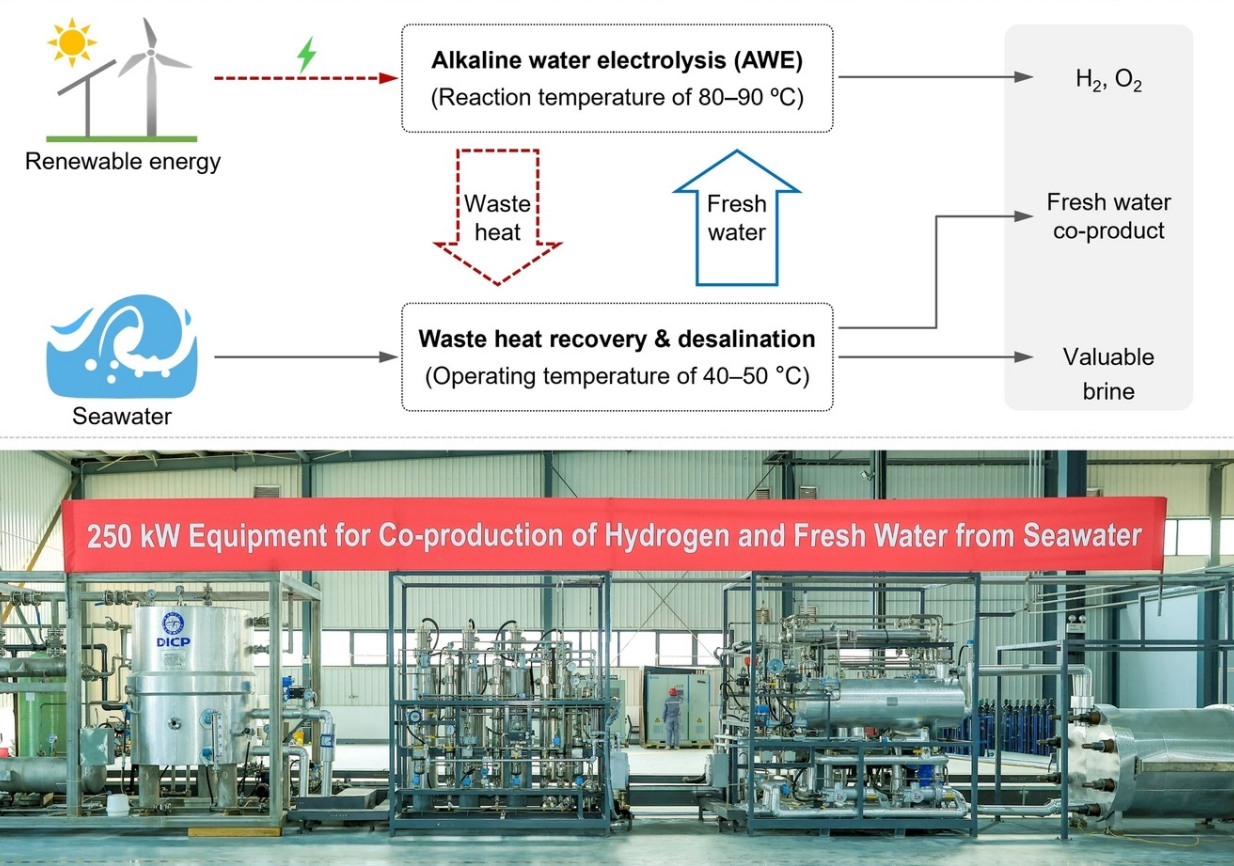
Chinese scientists have built a 250-kilowatt plant that makes hydrogen and fresh water from seawater in a single system, reusing the electrolyzer's waste heat to raise electrical efficiency by 14.4%.
The team, led by professor Deng Dehui and associate professor Liu Yanting of the Chinese Academy of Sciences' Dalian Institute of Chemical Physics, published the results on Sept. 15 in the peer-reviewed journal Nature Energy.
The plant produces 48 standard cubic meters of hydrogen and 31.6 kg of fresh water an hour, according to the paper.
That is equivalent to about 380,000 standard cubic meters of hydrogen at 99.9999% purity and 256 metric tons of fresh water a year, the South China Morning Post reported.
The concentrated brine left over can also be used to recover salt, uranium and bromine, the academy said in a statement, which gave no recovery figures for those materials.
Direct electrolysis of seawater exposes the anode to corrosion from chloride ions and the cathode to scale from calcium and magnesium ions, while the established alternative of desalinating seawater before electrolysis requires costly equipment and heavy electricity use, according to the SCMP.
Commercial alkaline electrolyzers run at 80 to 90 degrees Celsius and lose about 30% of their electricity as low-grade heat, which is usually carried away by cooling water. The Dalian team instead feeds that heat into a vacuum distillation tower, where seawater boils at 40 to 50 degrees Celsius and the vapor condenses into fresh water, enough to supply the electrolyzer with some left over, the newspaper reported.
The plant ran for 40 days of daily start-stop cycles with no obvious decline, and an earlier 20 kW pilot ran stably for 100 days, according to the academy.
Exhibitor/Conference Consultation
Contact: Ms. Becky CHEN
Tel: +86 15910580218
Email: becky@cntigerexpo.com
Exhibitor Consultation
Contact: Mr. Lito HU
Tel: +86 13601321637
Email: lito.hu@cntigerexpo.com
Exhibitor Consultation & Media Cooperation
Contact: Ms. Yasmin ZHENG
Tel: +86 13621183385
Email: zhengyaxin@cntigerexpo.com


