Release time : 2026-11-25 Source :Organizing Committee
China's first 5 MW alkaline–proton exchange membrane (ALK–PEM) hybrid hydrogen production system has been included in the National Energy Administration's (NEA) sixth batch of first-of-a-kind major technical equipment for the energy sector.
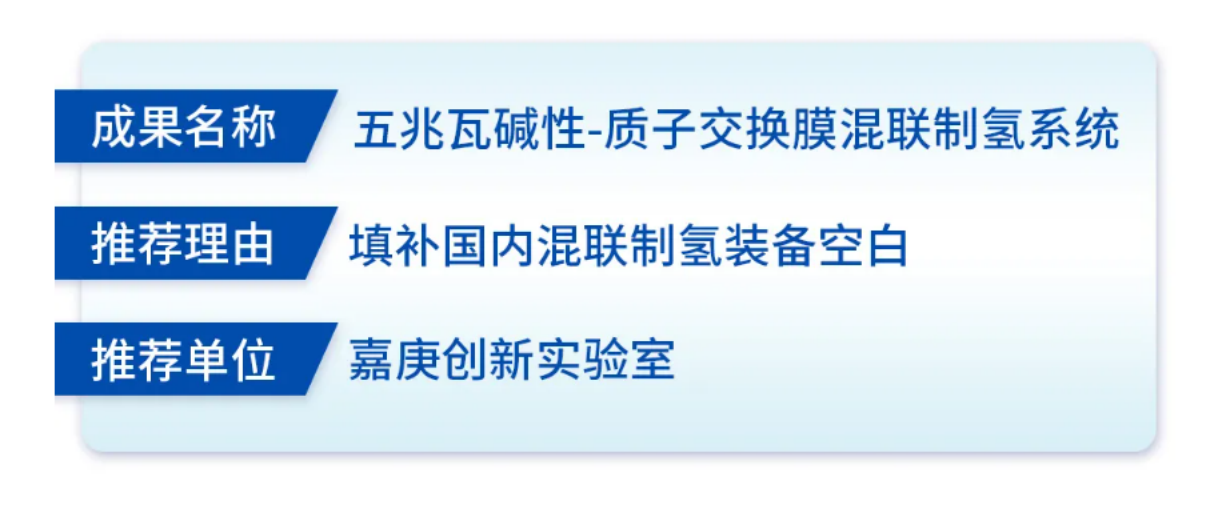
The system was developed by Tan Kah Kee Innovation Laboratory (formally known as Fujian Science & Technology Innovation Laboratory for Energy Materials of China), in collaboration with China Energy Investment Corporation (CHN Energy), Xi'an Jiaotong University and other companies and academic institutions. The NEA published the sixth-batch list on November 2, 2026.
The development addresses a key challenge in scaling up green hydrogen production: adapting electrolysis systems to the fluctuating electricity supply from wind and solar power.
Alkaline (ALK) electrolysis offers relatively low production costs but responds slowly to changes in power supply. Proton exchange membrane (PEM) electrolysis, by contrast, offers faster response times and greater operational flexibility, but comes with higher costs. Using either technology alone makes it difficult to balance operating costs with the flexibility required to accommodate variable renewable power.
To overcome this limitation, Tan Kah Kee Innovation Laboratory integrated ALK and PEM electrolysers into a single hydrogen production system, using a coordinated energy management system to optimise their operation.
The hybrid configuration is designed to accommodate intermittent and fluctuating renewable power while reducing operating costs. It offers a more economical, flexible and reliable approach to renewable energy integration and large-scale hydrogen production.
The system has been deployed in the Ningdong Renewable Hydrogen Carbon Emission Reduction Demonstration Zone in Ningxia, where it has completed long-duration operational tests under both summer and winter conditions.
According to test results released by the laboratory, the system can produce up to 1,000 Nm³ of hydrogen per hour and operate stably across an exceptionally wide load range of 16%–160%. Its response time is as short as 10 seconds, while specific energy consumption is as low as 4.3 kWh/Nm³.
The laboratory said the overall performance had reached an internationally leading level, filling a gap in China's domestic ALK–PEM hybrid hydrogen production equipment.
Exhibitor/Conference Consultation
Contact: Ms. Becky CHEN
Tel: +86 15910580218
Email: becky@cntigerexpo.com
Exhibitor Consultation
Contact: Mr. Lito HU
Tel: +86 13601321637
Email: lito.hu@cntigerexpo.com
Exhibitor Consultation & Media Cooperation
Contact: Ms. Yasmin ZHENG
Tel: +86 13621183385
Email: zhengyaxin@cntigerexpo.com