Release time : 2026-10-29 Source :Organizing Committee
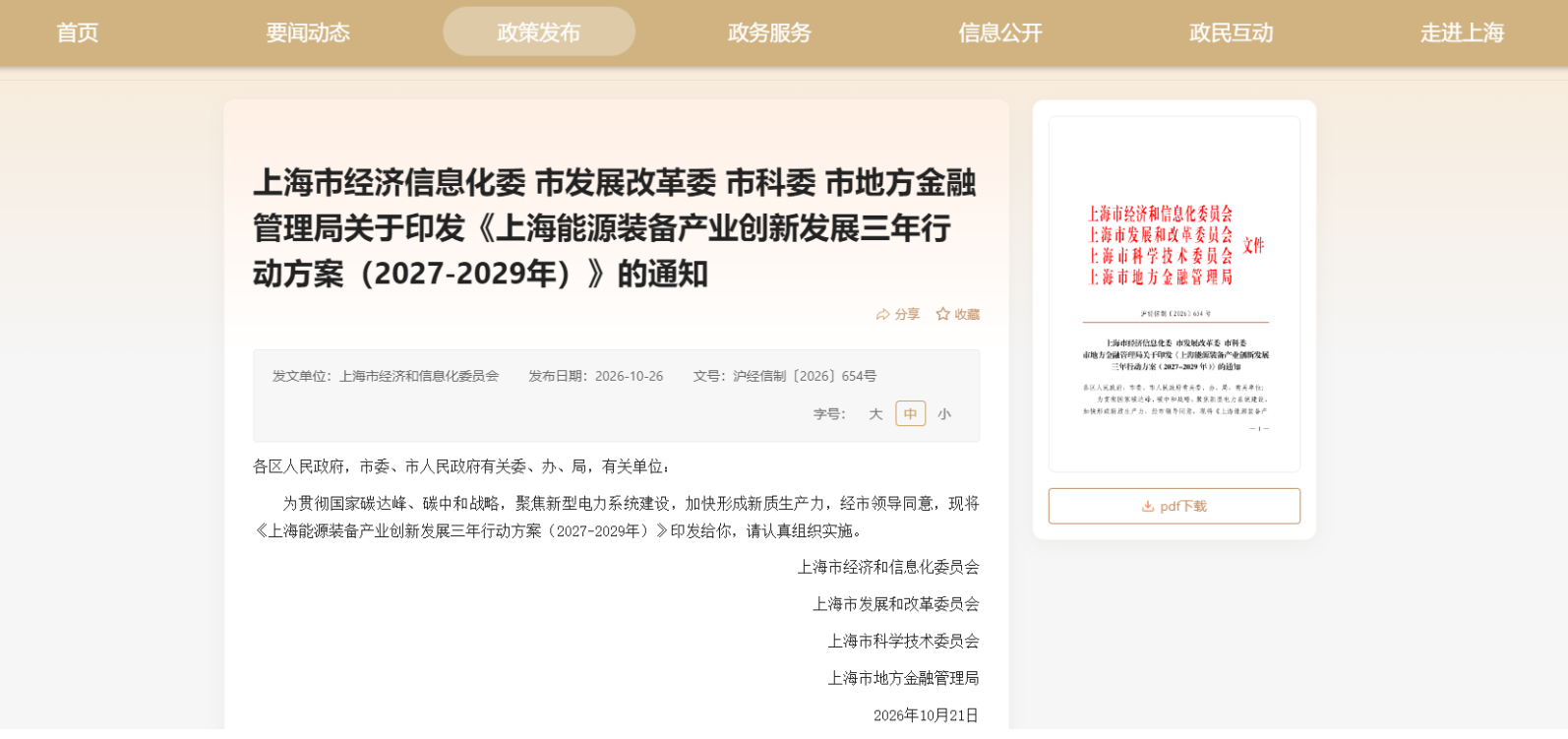
The Shanghai Municipal People’s Government released the Three-Year Action Plan for Innovative Development of Shanghai’s Energy Equipment Industry (2027–2029) on October 26, 2026. The plan was jointly issued by the Shanghai Municipal Commission of Economy and Informatization, the Shanghai Municipal Development and Reform Commission, the Shanghai Science and Technology Commission, and the Shanghai Local Financial Administration. The document is dated October 21, 2026.
Under the plan, Shanghai aims to increase the output value of its energy equipment industry to RMB 400 billion by 2029. The city plans to establish three industrial clusters, each targeting RMB 100 billion in output value, in Minhang, Songjiang and the Lingang New Area. It also aims to develop six emerging sectors, each targeting RMB 10 billion in output value, including advanced nuclear energy, hydrogen-based energy and offshore wind power. In addition, the plan identifies 10 flagship products, including microreactors, industrial gas turbines capable of operating with high hydrogen blends, and 25 MW-class floating offshore wind turbines for deepwater applications.
The plan dedicates a section to developing an integrated hydrogen equipment industry chain covering production, storage, transportation, refuelling and end use.
Key priorities include advancing the development and demonstration of fuel cell stacks, with a focus on high-power stacks and improvements in the reliability, stability and durability of critical materials such as catalysts, proton exchange membranes and carbon paper. Shanghai also plans to develop high-performance, low-cost membrane electrode assemblies and accelerate technological breakthroughs in sustainable aviation fuel (SAF).
The plan further supports the development of large-scale, high-efficiency alkaline, proton exchange membrane (PEM) and anion exchange membrane (AEM) electrolyzers, alongside equipment for the production, storage, transportation and refuelling of various green fuels. These efforts are intended to support the integrated development of equipment for green hydrogen, green ammonia and green methanol across the production, storage and end-use chain.
Beyond hydrogen production equipment, the plan calls for exploring new gas turbine technologies capable of operating with high hydrogen blends or pure hydrogen. It also supports the development and deployment of equipment for power generation using green ammonia co-firing.
Shanghai will encourage energy projects, including those involving solid-state hydrogen storage and fuel cells, to prioritize the procurement of first-of-a-kind equipment that has undergone validation and demonstration. Subsidies will be provided for pioneering products that achieve commercial sales and deployment.
The city will also promote integrated demonstration projects combining wind power, solar power, energy storage and hydrogen at ports, terminals and other suitable locations.
Looking ahead, Shanghai aims to increase the total output value of its energy equipment industry to more than RMB 500 billion by 2030, positioning the city as an internationally leading hub for energy equipment innovation and a launchpad for overseas expansion.
Exhibitor/Conference Consultation
Contact: Ms. Becky CHEN
Tel: +86 15910580218
Email: becky@cntigerexpo.com
Exhibitor Consultation
Contact: Mr. Lito HU
Tel: +86 13601321637
Email: lito.hu@cntigerexpo.com
Exhibitor Consultation & Media Cooperation
Contact: Ms. Yasmin ZHENG
Tel: +86 13621183385
Email: zhengyaxin@cntigerexpo.com


